Science
Professional Development and Parent Resources
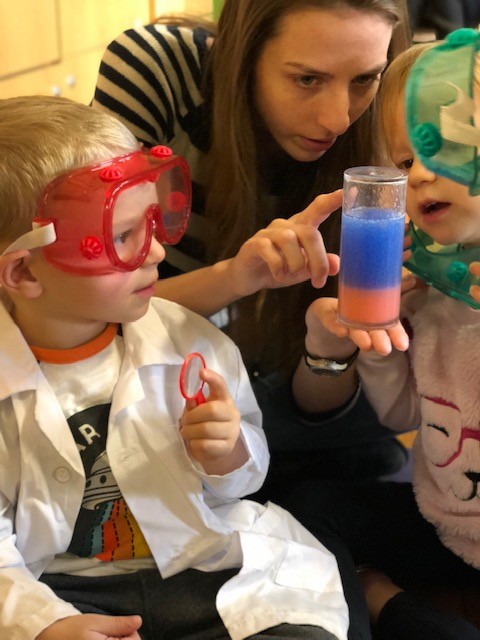
You don’t have to be an expert in science to support a child’s science learning. Simple activities can teach the key science concepts of volume, density, measurement and weight. Children will discover through trial and error and forming individual “conclusions.”
The following are some great projects that you can use to explore science skills such as sensory awareness, mixing and experimenting, and fine motor skills.
Para solicitar la version en español de las lecciones que estan en este website envie un email a playislearning@cmom.org
Washing Baby Dolls
Children will become aware of their body and introduced to exploring the properties of water as they wash and care for baby dolls.
Developing Skills:
• Body Awareness
• Fine Motor Skills
• Language Skills
• Science Skills
• Self-Confidence
• Sensory Awareness
Materials:
Baby dolls, tubs, water, soap, sponges, small cups
Set-up:
Place a baby doll in a tub in front of each seat. Fill the tub with a small amount of water and add a little soap and sponges.
Introduction to Project:
As each child sits down, invite them to explore the water and washing the baby dolls. Some of the children will be interested in playing with the water, while other will want to wash the baby doll.
This may be a little messy with water play taking place, so be sensitive to the children who simply want to wash the babies and not get wet. You may also water to incorporate some water songs such as “Row, Row, Row Your Boat.”
Exploring the Process with the Children:
What does the water feel like?
What happens when you mix the water and the soapy bubbles to wash the baby?
What do the soapy bubbles look like?
Do you like to take a bath?
Who can find their baby’s belly button? Nose? Back?
Building Art Vocabulary:
Wet, soapy, bubbles, slippery, different body parts
Guiding and Supporting the Parents Role:
It may be difficult for parents to take a step back and allow their children to explore the materials fully and at their own pace. Provide art smocks so parents will not worry about their children getting wet. Encourage discussion about caring for the baby doll and identifying body parts as children wash and care for the baby.
Clean-up:
Give children a five minute signal. Always let children know that you will be transitioning and ending the project soon. After the warning, sing a “clean-up song” to focus children and encourage participation in the clean-up process. One example is: “Clean up, clean up, one two three. I’ll help you and you help me. Clean up, clean up, one two three. I’ll help you and you help me.”
Book Connection:
You may use the books before or after the art projects to encourage the themes explored.
More, More, More Said the Baby by Vera B. Williams
ZA-ZA’s Baby Brother by Lucy Cousins
On Mother’s Lap by Ann Herbert Scott,
Peter’s Chair by Ezra Jack Keats
I Like Me! by Nancy Carlson
Water Color Painting
Children will explore water and mixing colors through the use of water color paints.
Developing Skills:
• Color Recognition
• Directionality
• Fine Motor Control
• Sensory Awareness
Materials:
8 ½ x 11 oak tag paper (card stock or thick paper), masking tape, large brushes, water color paints, water, containers for water. Note: you may choose to use wet paper towels or sponges in containers so there is less refilling of clean water.
Set-up:
Place a piece of 8 ½ by 11 oak tag paper at the edge of the table and masking tape down each corner of the paper. Place the brush on the right hand side of the paper. Place the watercolor paints at the top of the paper or to the left hand side of the paper. Have a few water containers in the middle of the table so each child can share and reach comfortably.
Introduction to Project:
As each child sits down, help them identify each of the different colors they see, encourage them to explore and choose colors at their own pace. Some of the children will be interested in simply mixing the paint in the trays or with the water, while others will want to paint on the paper with the brush.
Young children will probably combine all the colors together, but you can point out the different color combinations that they create as they explore.
Show children the sequence of dipping the brush in the water then placing the brush in the paint. This is also a good way to introduce problem solving with the children showing how, in order to paint with a new color, you must clean your brush first.
Exploring the Process with the Children:
What colors can you make with your paints?
What happens when you mix the water with the paint?
How does the water feel? Wet? Cold?
Can you change how the colors look by adding more water? Do they look lighter? Darker
Building Vocabulary:
Wet, slippery, cold, watery, light, dark
Guiding and Supporting the Parents Role:
It may be difficult for parents to step back and allow their children to paint at their own pace; they may try to rush the process by asking them to add another color before the child is ready. Many parents will want their children to make specific colors such as green or orange right away. Help parents/caregivers understand that by giving their child the opportunity to explore and mix at their own pace, their child will become focused and expressive as they paint.
By creating colors on their own, children discover, explore and learn. The process of water color may be a new way to paint for some children so the addition of water may take over the interest in the paint. Try to tell parents that this project is about the process of mixing the paint with the water and not about the finished product.
Clean-up:
Give the children a five minute warning. Always let the children know that you will be ending and transitioning. After the warning, sing a clean-up song to encourage all the children to assist in the clean-up process. One example is: “Clean up, clean up, one two three. I’ll help you and you help me. Clean up, clean up, one two three. I’ll help you and you help me.”
Book Connection:
You may use the books before or after the art projects to encourage the themes explored.
Mister Seahorse by Eric Carle
Way Down Deep in the Deep Blue Sea by Jan Peck
Color Dance by Ann Jonas
Create Your Own Lesson Plan
Be inspired and learn the how to create your own lesson plan.